
Medical Apocalypse
How doomist thinking about our bodies makes us sick


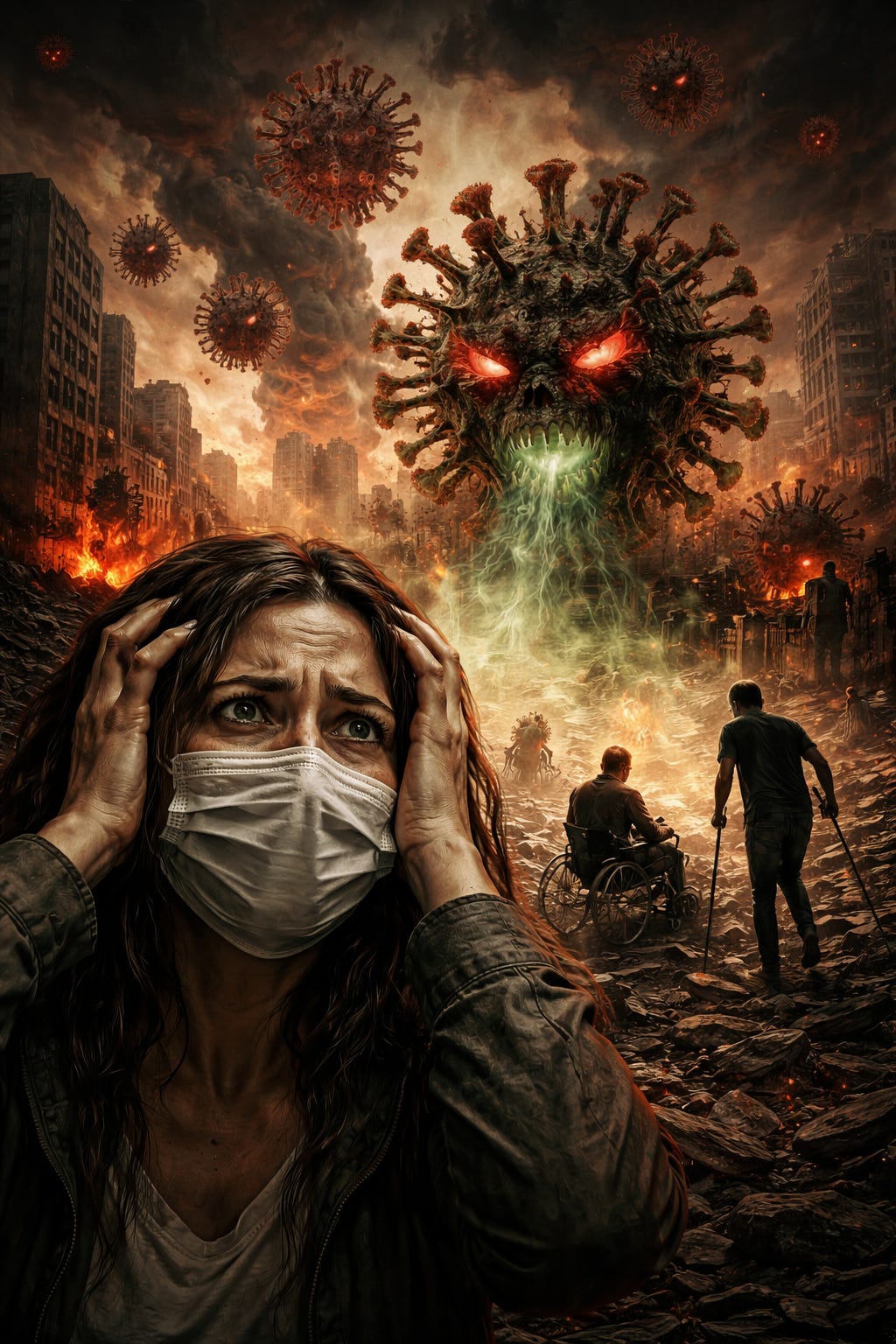
In 1934, Los Angeles was in the middle of a severe polio epidemic. There were 1,700 cases in the city alone. At the county hospital an unprecedented number of staff seemed to fall ill. Nearly 200 of them reported polio symptoms by the end of the year. The trouble was that few of them showed the usual signs. No paralysis. No abnormalities in their spinal fluid. All patients seemed to show, besides outward signs of being sick, were minor motor impairments. They couldn’t have had polio.
Investigators christened this new disease, one that seemed to have little to do with any specific germ and posed no risk of death “benign myalgic encephalitis.” You might have heard it called chronic fatigue syndrome, or at least heard of its cousins: fibromyalgia and long COVID. These are contested illnesses whose sufferers complain of extreme malaise after mental or physical exertion, sleep disturbances, pain, and other flu-like symptoms. Except, unlike the flu, the illness never seems to go away.
All contested diseases pose the same scientific dilemma: When medical scientists and doctors can’t seem to find something unequivocally wrong with a sick person, is it because they haven’t looked in the right places or because there’s nothing to find?
In an earlier post with The Ecomodernist, I argued that apocalyptic thinking undermines sensible environmental politics. It leads people to exaggerate the scientific certainties, to see politics in fanatical black and white terms, and to refuse to acknowledge the on-the-ground challenges involved in solving global environmental problems. I now recognize the same kind of thinking as at work in keeping people ill. When we view our own bodies through an apocalyptic lens, we throw out any hope of getting better.
The Power of the Mind
Some investigators of the apparent polio outbreak at Los Angeles County Hospital eventually concluded that staff members’ symptoms were the product of mass hysteria, fear of the disease rather than the germ itself. They didn’t do so without good reason. There’s a long history of hysterical disease epidemics. Hundreds of peasants literally danced themselves to death in the middle ages as the belief of a spreading “dancing curse” combined with the threat of famine and the stresses of everyday medieval life. Other hysterias have caused paralysis, rashes, tremors, and even unceasing fits of laughter.
The hypothesized mechanism behind these outbreaks is a kind of reverse placebo effect. The normal placebo effect occurs regularly. Give people a sugar pill and their expectations for improved wellbeing can actually cause physiological improvements. It’s something that confounds most medical trials. When it comes to mass psychogenic illness, it’s the expectation of disease that literally makes people sick.
No doubt that it is always possible that there really was an infectious or toxic agent in such cases, and that we have just failed to discover it. Stomach ulcers were waived off as a product of stress, until someone discovered H. Pylori bacteria in the guts of sufferers. The Spanish flu left some victims with severe Parkinsons symptoms. Why couldn’t COVID leave people permanently ill?
Decades of research has yet to deliver a clear biological etiology for conditions like chronic fatigue syndrome and fibromyalgia. Studies have uncovered genes and other biological markers, like signs of neuroinflammation, that seem associated with these chronic illnesses, but nothing that really reliably distinguishes those who suffer and those who don’t. Suspect biomarkers are often present in healthy people too. And for discovered abnormalities that seem unique, we can’t know whether they are cause or effect, given that we know through the placebo effect that the mind can cause changes in our bodies.
At some point, a lack of conclusive physiological evidence suggests at least some psychogenic element for some portion of the chronically ill. Even if the Spanish flu did cause post-viral illnesses in people, it’s also pretty clear that an outbreak of debilitating nervous tics among young women during the COVID pandemic was simply a case of mass hysteria.
But that is something that is very hard for sick people to accept. When someone utters word psychosomatic or psychogenic, patients hear “fake” and “crazy.” Suffering people understandably want to feel validated, and the diagnosis gets off to a bad start almost by default. It sounds like an ad hoc excuse, something doctors say when they hit the limits of their expertise and just want an inconvenient patient to go away.
That seems like a plausible argument, except when you learn that there are many people who have gotten better simply by recognizing the psychological nature of their suffering.
An early proponent of the psychogenic theory of common ailments, including back pain, irritable bowel syndrome, and headaches, was the late NYU medical professor John Sarno. He claimed to have cured tens of thousands through his clinical practice, which included celebrities such as Larry David and John Stossel just by convincing them it was psychosomatic. Sarno’s claims no doubt outpaced the available medical research. He himself couldn’t see how getting people to see their pain in Freudian terms, as a product of repressed emotion, and having them simply go back to living their lives without dwelling on their symptoms could be tested through a randomized trial.
Recent studies, however, do seem to confirm Sarno’s main intuition (who knows about the Freudian stuff). In one trial of pain reprocessing therapy, 66 percent of treated back pain sufferers were pain free or almost pain free after only four weeks. This was multiple times more effective than a placebo or usual care. Five years later, 55 percent of the group treated with pain reprocessing therapy still had little to no pain. For anyone who follows medical studies, an NNT (“number needed to treat”) less than two beats most of the medicines that people take.
What the Body Reveals
The claim that at least some chronic illnesses are psychogenic, caused by the way that we think about them, conflicts with our commonsensical notion of disease. If we have pain or dysfunction, there must be a biological cause. It is something that happens to us. How could it possibly be that we could being doing it to ourselves?
When it comes to chronic pain, we can point to medical imaging. Reduced joint spacing, bulges in our spine, bone spurs, and others flaws show up objectively on film. There. That’s the culprit.
Sarno would dismiss these as “normal abnormalities,” based on his assessment that many people’s symptoms seemed disproportionate to the physiological incongruities seen in X-rays and MRIs.
And there is some evidence giving credence to Sarno’s argument. A large portion of people appear to have arthritis on x-rays, but no symptoms. Rotator cuffs can often be torn and vertebral discs herniated, seemingly without people being any worse for wear. Absent better diagnostics about the physiological causes of pain, the main difference in many cases seems to be simply patients’ reported suffering, how powerful their mind is in creating and sustaining the experience of pain.
The question, of course, is how far the psychogenic pattern of chronic pain extends to other symptoms, such as fatigue, gastrointestinal distress, and dizziness. To my knowledge, the studies haven’t been done. But it no longer seems like such a big a leap of logic to wonder that, if people’s brains can keep them debilitated with chronic back pain, then maybe our minds can also give us the symptoms of chronic fatigue or long COVID.
Given the fact that COVID quickly became one of the most scientifically scrutinized illnesses of all time, we are likely to have uncovered all sorts of seemingly new, but potentially normal, abnormalities. Scientists have found innumerable physiological impacts of COVID, minute bodily changes—some of which probably occur after infections by viruses—and might have remained undiscovered if it weren’t for the pandemic focusing our attention on them. But the sudden revelation of these impacts makes COVID seem like an unprecedented attack on our immune systems, a “mass disabling” crisis in the making. But such thinking might be the very thing that has rendered so many people ill.
But patients’ lived experience can just as easily be bullshit as any slapdash scientific study.
When interviewed for a New Yorker article on fibromyalgia in 2000, Harvard psychiatry professor Arthur Barsky argued that sufferers “become trapped in the belief that their symptoms are due to disease; with future expectations of debility and doom. This enhances their vigilance about their body, and thus the intensity of their symptoms.”
In other words, chronic psychodynamic illnesses are, at least in part and for some cases, driven by apocalyptic, revelatory thinking. Chronic fatigue, fibromyalgia, and long COVID sufferers insist that their symptoms reveal a broken body. The lack of medical succor reveals a broken medical system, if not society
“Long COVID is not a tragedy, it’s government negligence,” argue some activists. Others warn readers of national newspapers that “Long COVID has derailed my life. Make no mistake: It could yours, too.” COVID has been transformed from a virus that can kill in rare cases but is otherwise an inconvenience, into one that instead threatens everyone with apocalyptic disability.
When Lived Experience Lies
I suspect that we will look back on the long COVID movement and hear echoes of the polio hysteria at Los Angeles County Hospital. To be clear, my point isn’t that chronic illnesses, such as long COVID, are invented whole cloth. Or that people aren’t genuinely suffering. Neither do I want to imply that there’s no physiological element to psychogenic illness. I’ve experienced it myself.
I suffered for years with a chronic vestibular dysfunction that began as a severe viral infection. Doctors had to mainline Dramamine into my veins in order to stop the dry heaves. Six days later, when I could still barely handle walking down the hallway before needing to rest, they insisted that my brain would eventually adapt around the vestibular injury and released me from the hospital.
When some of my symptoms persisted or returned, such as the nausea that I felt under certain kinds of light and in crowds or the extreme fatigue that I felt after driving, I suspected the worst. I even considered going on disability when I had days when I felt like I couldn’t keep up. I’m sure those who believe they have chronic fatigue syndrome or long COVID have similar stories to tell.
Despite these symptoms, even more fringy practitioners struggled to help me, while traditional doctors waived off my complaints. The slightly kooky vision therapist that I saw tried make me prism glasses, only for them to seem to disturb my balance even more. The mainstream neurologist recognized that my life wasn’t in immediate danger and quickly shooed me out of his office. When I said that I hoped to return to playing soccer and rugby, he told me in his kiwi accent, “Come on. I think you’re done, mate.”
Had I insisted on many more brain scans and blood tests, I might well have uncovered still more physiological abnormalities of unknown significance—ones in addition to the few that I madly Google searched after standard MRIs and CTs. And negative results could always be waved away, a sign of medical incompetence, the failure by the so-called experts to find what my body and brain were so clearly telling me was really there.
My chronic vertigo and associated fatigue didn’t get better until I tried to resist the siren song of apocalyptic medicalization, the nagging voice that sees debilitation behind discomfort. Also helpful was trying to not have such unrealistic expectations of myself, high standards that drove me to ignore my body when it asked for rest and crash out on the weekends.
I recognized that apocalyptic thinking about my body led me to tense up my neck and facial muscles when I experienced brief relapses of vertigo, to tire myself out even more by dwelling about feeling fatigued, and to make myself crazy with dreamed up catastrophic scenarios in which I never played sports again or was forced to quit my job. I learned to more often let discomfort simply be discomfort, and to try to let it go.
During my PhD in Science and Technology Studies, it seemed like everyone viewed citizen health movements as full of heroes, as people with “embodied expertise” who were pushing back against the scientization of illness (partly because it was still before right wingers had their own health movements). But patients’ lived experience can just as easily be bullshit as any slapdash scientific study.
The heroic image of sick people striking a blow for healthcare justice has prevented the field from paying attention to the possibility that health activism and social movements for contested illness might, at least in some cases, be iatrogenic. Efforts to validate chronic fatigue syndrome or long COVID as “legitimate” physiologically caused diseases may be literally making many people sick. Activism may be dragging innocent people, who would have gotten better on their own, into the abyss of apocalyptic health thinking.
The Siren Song of Apocalyptic Medicalization
Unfortunately, apocalypticism in all its forms is more easily analyzed from a distance than actually coped with—I can attest to that personally. Coping means learning to live with uncertainty, to resist diagnosing every imperfection as revelation of doom, and to insist on practicing a faithful, even if naive, optimism about the future—whether about one’s own body or the planet.
I’m not sure what I would say to someone with long COVID, were they sitting right in front of me. When I’ve tried to help friends and family who seem to be struggling with what clearly looks like psychogenic pain: tennis elbow that just so happened to develop after a promotion to a management position, a knee that became dodgy after moving in with a new romantic partner but looked clean on an MRI, and countless others, I’m unsure if I’ve convinced any of them. They seem to half listen to me recount my experiences and conclude quietly to themselves: “Well, maybe he’s a crazy person whose dysfunctional brain kept him ill, but my suffering is REAL!”
After years spent trying to persuade people that they are often their own worst enemies, whether it is the stubborn belief that their political opponents are all brainwashed or corrupt, the insistence on a coming environmental apocalypse, or the preoccupation with seeing bodily dysfunction as invariably physiological, I am stuck with two possible conclusions: Either persuasion is nearly impossible for most high-stakes, highly emotional issues, or I am just bad at it.
There are just not any obvious ways to disabuse someone of apocalyptic thinking that allows them to save face. I’m embarrassed that my mistaken thinking about my body kept me from driving and playing sports for years longer than was necessary. Just like I’m embarrassed about how seriously I took 2010s claims about peak oil and a climate crisis being right around the corner. But somehow I changed my own mind. And I worry that millions are doomed to needlessly suffer unless we can figure out how to more reliably inoculate people against the allure of the apocalyptic.
 | A guest post by
|
Good stuff! Has me thinking about the power of the mind with such things like empathetic pregnancies, partners who experience the symptoms of pregnancy when their partner is pregnant. Turns out it's just mental. Why is it harder to accept some of the mental explanations than some biological mechanism?
Discovered after posting: A study finding that symptom perceptual retraining helped reduce symptoms in long COVID patients. Caveats: small size and lack of a comparison group. So, not definitive, but to me suggests that I'm not totally off base in my reasoning here (regardless of whatever biomarkers get discovered this year). https://static1.squarespace.com/static/52813cfbe4b00150d038dcf8/t/64d27f4b9cdf2763fa053961/1691516747741/PIIS2542454823000280.pdf